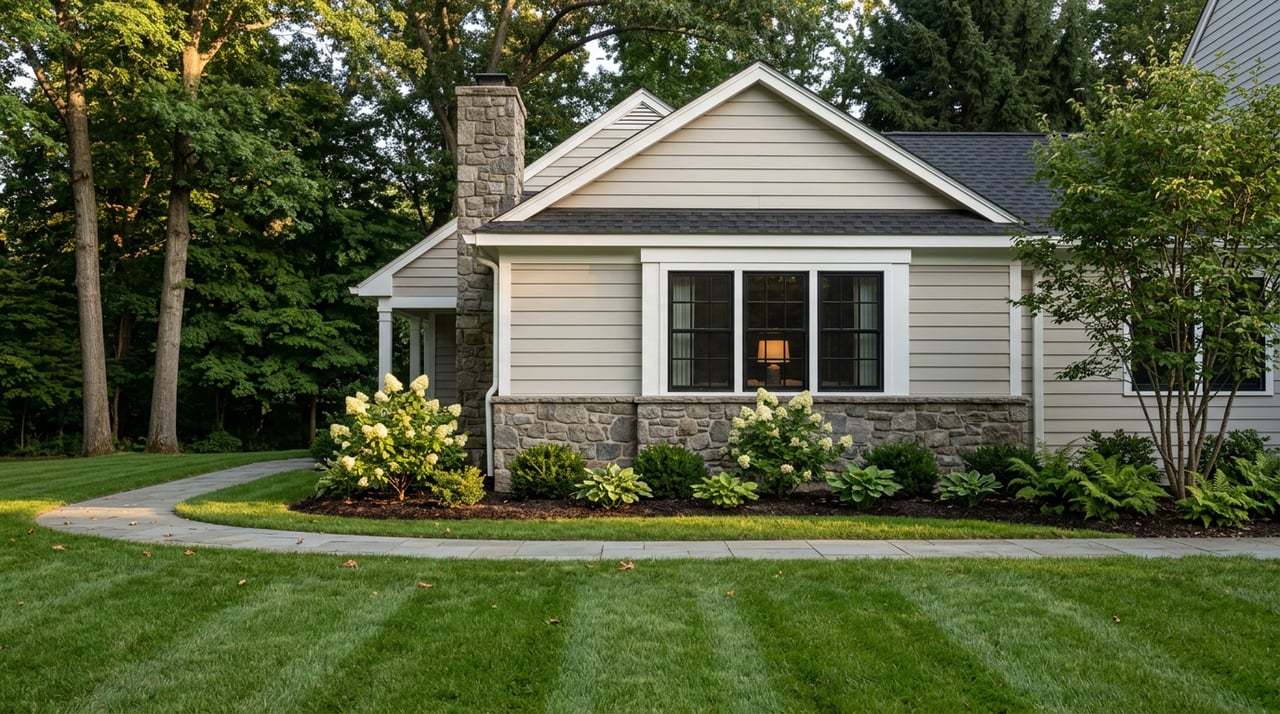
Every buyer who calls about Goshen has already Googled the median. They arrive with a number in mind, usually somewhere between $500,000 and $600,000, and they want to know what that number gets them. The honest answer starts with a warning: in a market this small, the median is a starting point, not a description. The same $580,000 in Goshen can buy a Federal-style village home two blocks from the courthouse, a 2005 colonial on a cul-de-sac inside a named subdivision, or a smaller farmhouse on two acres down a country road. Those are three different lives, and the portal number blurs all three into one.
The three-month rolling median single-family sale price across the Village and Town of Goshen sat at $579,900 as of May 2026, with price per square foot near $283 and essentially flat against the roughly $600,000 median a year earlier. That number is real. It is also the least useful figure in the report if you are trying to decide where in Goshen to actually look.
The thesis is simple: Goshen is not one market at one price. It is three sub-markets sharing a headline, and the market has quietly softened enough in the last twelve months to give a prepared buyer real negotiation room that did not exist last spring.
The $85,000 Gap Nobody Explains on the Portal
Start with a mechanic that only shows up when you look at both averages side by side. Over the same May 2026 window, the three-month mean sale price in Goshen ran about $665,089 against that $579,900 median, a spread of roughly $85,000. In a large metro, that gap would suggest a slightly top-heavy mix. In Goshen, where only a handful of single-family homes close in any given month, it means one or two rural estate sales or a large-parcel equestrian transaction rewrote the "average" for the entire town.
One month in 2026 the monthly median even spiked to a record $732,500 on just six closings, while price per square foot barely moved. Nothing had actually changed on the ground. Six people bought six specific homes, and three of them happened to be at the high end of the tail.
The reader takeaway from that is not "prices are volatile." It is that Goshen's headline number is a moving target driven by whichever three or four homes closed most recently, and any pricing conversation, whether you are listing or offering, needs to be grounded in comparables that match your actual street, square footage, and condition rather than the county-wide average. A single Zillow figure is a rough compass. It is not an appraisal, and it is not a strategy.
What "Goshen" Actually Means on a Listing
There is a Village of Goshen and a Town of Goshen. The Village is the incorporated core with its own mayor and code enforcement. The Town wraps around it and reaches into open country. Both mail as "Goshen, NY 10924," and both show up in the same MLS search. They do not sell like the same place.
Inside those two boundaries, the housing stock splits cleanly into three sub-markets that a buyer's budget maps onto very differently:
| Sub-market | What you find there | Lot character | Trade-off against the median |
|---|---|---|---|
| Village core | Federal, Victorian and colonial-era homes on brick-lined streets near Main Street, the County Courthouse, and the Goshen Historic Track | Smaller village lots, sidewalks, walk to farmers market and the ShortLine bus stop | Pays a premium for walkability and architecture; less land per dollar |
| Subdivision ring | Named developments including Harness Estates, Woodlands at Harness, Heritage at Goshen, The Hills at Goshen, Creamery Valley Estates, and Meadows of Goshen, mostly built between the late 1980s and 2000s | Cul-de-sacs, 0.5 to 2.5 acre lots, colonials and ranches from roughly 1,800 to 3,500 square feet | Newer systems and floor plans at or near the median; suburban feel, not walkable |
| Country roads | Older farmhouses and updated capes on rural parcels, occasional equestrian properties | Multi-acre lots, well and septic, more privacy | Fewer comparable sales; more variance; the tail that inflates the mean |
The point of the table is not to rank the three. It is to show that a $580,000 offer written against a Village listing and a $580,000 offer written against a country-road listing are competing for entirely different housing stock, on entirely different lot economics, and against entirely different competing buyers. The number is the same. The transaction is not.
New construction lives slightly above all three. The three new-construction homes for sale in Goshen in June 2026 carried a median list price around $725,000, sitting materially above the resale median. If a buyer's search is filtered to "new construction only," the Goshen budget conversation starts closer to $700,000 than to $580,000, and the sub-market map above still applies to where those homes are actually going up.
The DOM Signal Nobody Talks About
The single most useful number in the current Goshen data is not the price. It is time.
Median days on market in Goshen reached 61 days as of May 2026, roughly double the 31 days recorded in May 2025. Price per square foot barely moved over the same twelve months. Read together, those two facts describe a very specific market shift: sellers are still holding their asking prices, but buyers are taking twice as long to say yes.
For a buyer, that is negotiation room that did not exist in spring 2025. A well-priced Village listing still moves quickly, but the Town listings sitting 45 to 75 days in still frequently accept inspection credits, closing cost concessions, or a 3 to 5 percent price adjustment that would have been laughed off last year. A patient offer, written after a listing has crossed the 60-day mark, is a strategy again.
For a seller, the same data reads as a warning against pricing to the top of the range. In a market where the median home takes two months to close, an aggressive first list price now costs weeks and often forces the eventual price reduction to be bigger than the concession would have been. The Goshen buyer pool has not disappeared. It has become more discerning, and it is comparing your listing to four or five others that a year ago would have sold before it reached the market.
Why the Sub-market Matters at Closing, Not Just at Search
Two friction points come up during Goshen transactions that a portal median cannot warn you about:
The first is the water and septic question on country-road properties. Homes outside the Village typically run on well and septic. Buyer diligence there is not the same as diligence on a Village property connected to municipal water and sewer, and the inspection budget and timeline expand accordingly. That friction is invisible on Zillow and shows up two weeks into contract.
The second is comparable scarcity in the estate tier. Because a handful of high-end sales pull the county-wide mean, appraisers working a $900,000 country-road home in Goshen may lean on comparables that closed six or nine months back, or across a district line. That can create appraisal gaps that a buyer without cash reserves is not positioned to bridge. The same $900,000 in the Village core, where recent comps are denser, tends to appraise cleanly.
Neither of these is a reason to prefer one sub-market over another. They are reasons to know which sub-market you are actually shopping in before you write the offer.
Short FAQ
Is Goshen still a seller's market in 2026? It is closer to balanced than it has been in several years. Median price is flat year over year, inventory inside the Village is thin at around 50 active listings in May 2026, and homes are sitting roughly twice as long as they did last spring. Well-priced homes still move. Ambitious pricing does not.
Does the LEGOLAND New York Resort effect still matter to home values? The resort opened in 2021 on 150 acres and remains the largest LEGOLAND in the Northeast. Five years in, the effect on residential values is mostly indirect: better road access via Route 17 improvements, more short-term rental activity in specific pockets, and steadier weekend traffic in and out of town. It is not a comp driver on residential sales.
Is new construction a better deal than resale at the same price? Not automatically. New construction in Goshen currently lists near $725,000, well above the resale median, and delivers newer systems, warranties, and floor plans built for how families use space now. Resale in the subdivision ring often delivers more finished square footage, a larger lot, and mature landscaping at the same or lower price. The right answer depends on whether you value newness or space more.
Ready to Read Your Own Number
The median tells you the market. Your street, your square footage, and your sub-market tell you your number. If you are weighing Goshen against Chester, Warwick, or Washingtonville, or trying to decide whether the Village premium is worth it for your household, JPL Signature Homes will walk you through the live comparables that match your actual search, in English or Mandarin, and translate the headline data into a specific plan for your street. Let's connect.
